What a catalytic converter replacement costs in Toronto
5 September 2026
There is no single honest number for what a catalytic converter replacement costs in Toronto, and anyone who gives you one over the phone without seeing the car is guessing. The real cost turns on whether your converter is OEM or aftermarket, how many your vehicle has, where it sits in the exhaust system, and whether the pipe, sensors or hangers around it got damaged too, whether from a failure or a theft. What we can do here is walk through exactly what drives that number, so a call to the shop gets you a real figure instead of a guess.
Why the price moves around so much
A catalytic converter is not one standard part. OEM converters, built to the manufacturer's exact specification, cost more than aftermarket equivalents, and on some vehicles only the OEM part will satisfy emissions requirements or clear a check-engine light properly. Some cars run a single converter. Others, particularly V6 and V8 engines, run two, which doubles the parts cost outright.
Where it sits matters too. A converter mounted low and accessible under the car is a straightforward swap. One built into the exhaust manifold, tucked up against the engine, takes longer to reach and costs more in labour for exactly that reason.
Then there is the condition of everything around it. If a converter failed on its own, the pipe on either side is often fine and the job is contained. If it was cut out by a thief, the story is usually messier. The pipe gets hacked through rather than unbolted, oxygen sensors are sometimes damaged in the process, and there can be a hanger or bracket that needs replacing along with it. Theft also brings insurance into the picture, which changes the conversation about what gets fixed and how, separate from the parts and labour themselves.
There is also a fitting difference that changes labour on top of everything else. A direct-fit converter bolts straight onto the existing flanges in roughly the spot the old one came out of. A universal converter has to be cut in and welded onto the existing pipe, which takes longer and needs a welder rather than a wrench. Whether a direct-fit part exists for your vehicle, or whether it has to be a universal fit, is one more thing that only becomes clear once someone has looked at the car.
None of that is a dodge. It is the honest reason nobody can quote a converter replacement without seeing the vehicle. The same question asked about two different cars can have answers that are nowhere near each other.
Why converters get stolen in the first place
Converters get targeted because the honeycomb inside is coated with small amounts of platinum, palladium and rhodium, the precious metals that trigger the chemical reaction cleaning up exhaust gases. That is the entire reason theft became a problem: a part worth relatively little to you as a spare has real scrap value to whoever cuts it out. One thing worth being clear on is that the scrap value of the metal has nothing to do with what a replacement part costs at the counter. One is a commodity price, the other is a manufactured part plus labour, and the two numbers aren't related. Converter theft is a well-documented problem across Toronto, which is exactly why so many drivers end up asking this question in the first place.
How to tell if it's actually the converter
A failing converter usually announces itself gradually. A rattle from underneath, especially on startup or over bumps, can mean the honeycomb structure inside has broken up and is loose in the housing. A rotten-egg smell from the exhaust points to the converter not processing sulphur compounds the way it should. A check-engine light is common, and so is a failed emissions test. The converter is the part built specifically to clean up what the engine sends out, so when it stops working, that is exactly where it shows.
Theft looks nothing like that. A stolen converter makes the car extremely loud the moment you start the engine. It isn't a slow build-up over weeks. It's a sudden, unmistakable roar from the first turn of the key. If that's what you're hearing, you already know the answer without needing a diagnosis.
The check-engine light deserves its own note. Most vehicles run a sensor on each side of the converter specifically to measure how well it is cleaning the exhaust, and a converter that has stopped working efficiently trips a catalyst-efficiency code, commonly P0420 or P0430, depending on which bank of the engine it's on. That code is a strong pointer toward the converter, but it isn't proof by itself: a leak upstream of the sensor, or a failing oxygen sensor giving a bad reading, can trigger the same code without the converter being the problem at all. That's exactly why the code gets treated as a starting point for a look underneath, not as a diagnosis on its own.
Converter problem, or something a lot cheaper?
A rattle is where people jump to the most expensive conclusion first, and it isn't always the right one. A loose heat shield, the thin metal panel that protects the underbody from exhaust heat, makes a very similar metallic rattle when a clip or bolt has worked loose, and it's a fraction of the cost to fix. A broken exhaust hanger lets the pipe sag and knock against the underbody over bumps, which can sound just as alarming and is also a much smaller job.
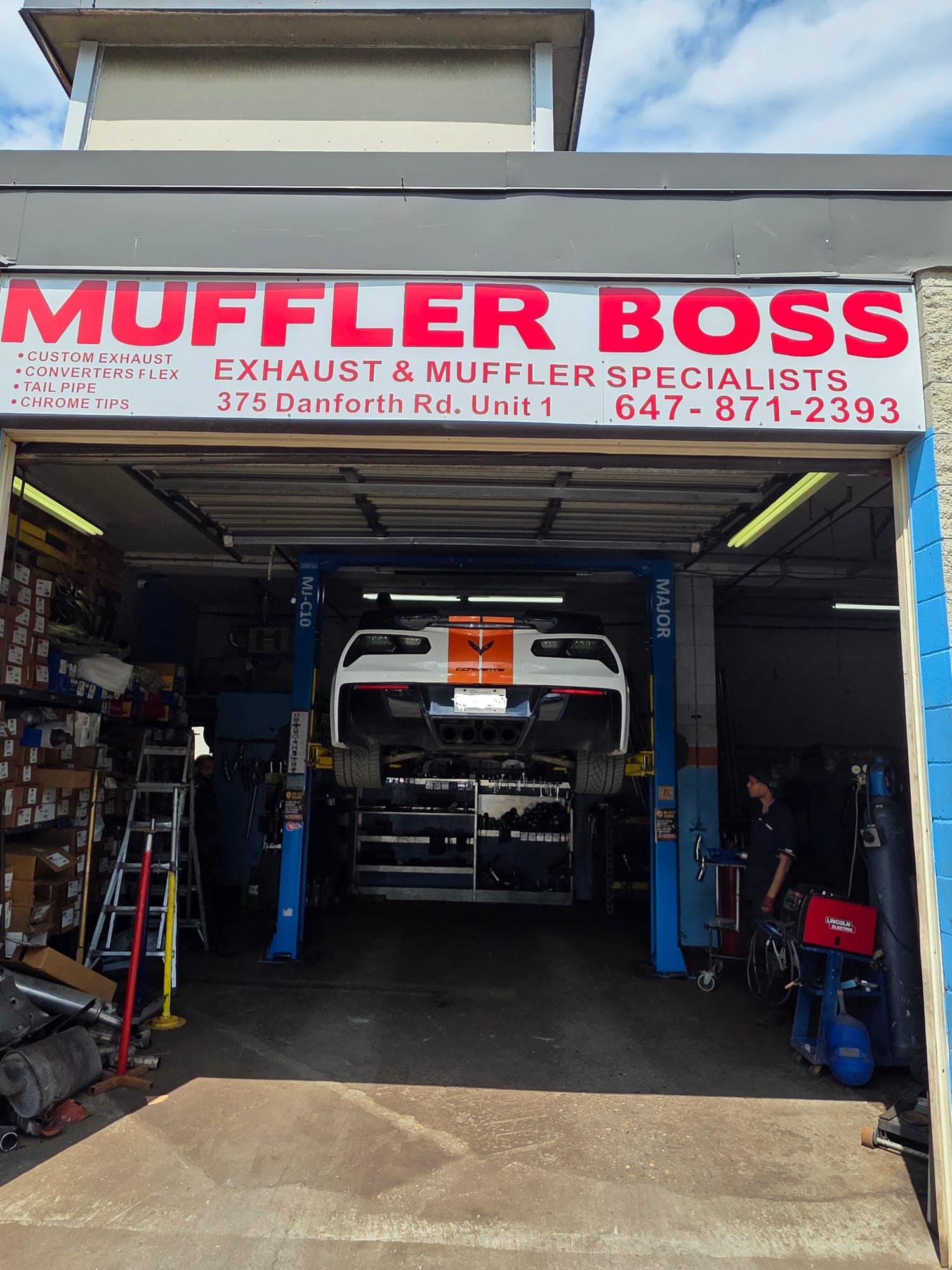
The only way to tell them apart is to get the car up on a hoist and look. That diagnosis is exhaust work, not converter work, and it's priced accordingly. Exhaust repair at Boss Tire starts at $150, before tax, which covers finding out whether you're looking at a loose shield, a broken hanger, a plain pipe leak, or something that actually points to the converter. See exhaust leak repair for how that diagnosis works and what it typically involves.
What we can do
A catalytic converter isn't a part we stock and fit at Boss Tire. What our exhaust bay can do is get your car up, look at exactly what's going on underneath, and tell you straight whether you're dealing with a converter, a pipe, a hanger or a sensor, and what that means for the job ahead. That's a more useful starting point than a number pulled from a search result for a car that isn't yours.
Call the shop with the year, make and model, and describe what you're hearing or smelling, and we'll tell you what we actually find. See everything we do in muffler & exhaust for the rest of what that bay covers.
Hearing a rattle or a roar?
Call the shop and we'll tell you exactly what's underneath, converter, pipe or hanger, before anything gets quoted.
4.8 from 334 Google reviews(opens Google in a new tab)